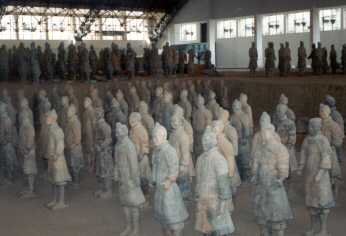
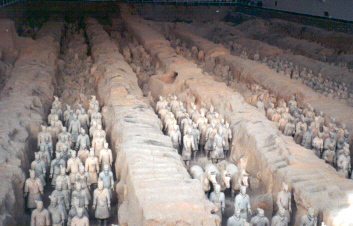
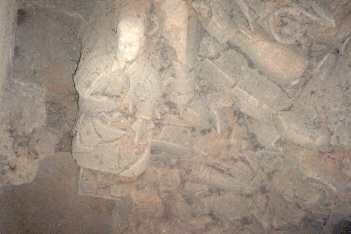
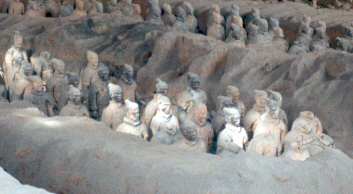
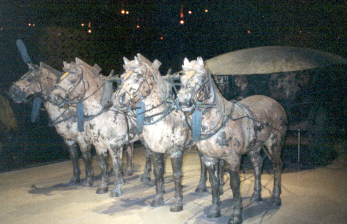
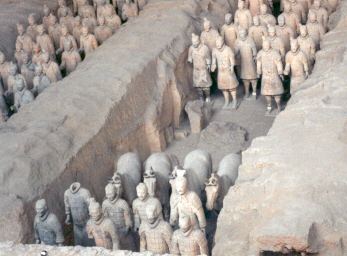
In 1974, at the foot of Mt. Lishan, peasants digging for well water accidentally discovered some ancient bronze weapons and pieces of broken terra-cotta statues. Excavation and research revealed an incredible archaeological find; one of three vaults of life-size terra-cotta soldiers, complete with weapons, horses and chariots, created by China's First Emperor, Qin Shi Huang who lived from 259 to 210 BC. 6,000 soldiers, out of a total of 8,000, reside in this first vault, however only 1,000 have been restored. The soldiers, with individual faces modeled from actual soldiers of the time, were arranged in 38 ranks, all facing east towards the Emperor's tomb. The excavation is housed in a building the size of an aircraft hangar.
The second vault is also an excavation in progress, and contains 900 archers, infantrymen, charioteers and cavalry, and 356 horses pulling 89 war chariots. It is housed in a more pleasing, climate controlled marble hall, which opened in 1994. The third vault is the smallest; its 68 figures appear to be officers, based on their dress, height and placement.
|
|
|
|
|
|
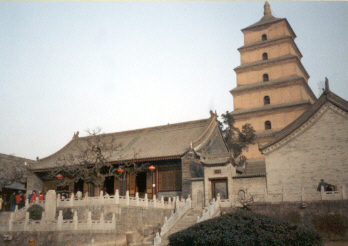
This impressive seven story Buddhist pagoda was erected in 652 AD (during the Tang Dynasty) as a fireproof storage facility for 600 scriptures brought from India and translated from Sanskrit by Xuan Zang, China's most famous Buddhist monk. The temple is located four kilometers southeast of the city wall's south gate.
 |
 |
 |
|