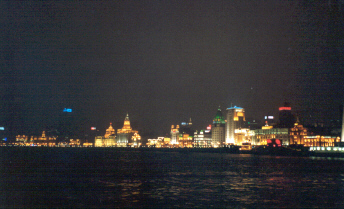
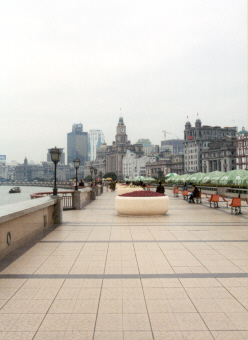
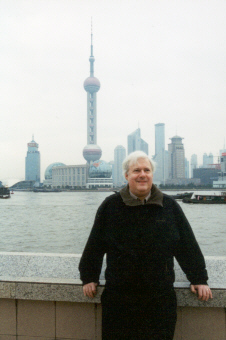
The Huangpu River cuts through Shanghai, dividing the city in two. The western side is the older, more romantic Shanghai, while the eastern side, called Pudong, is rapidly growing into a modern metropolis and financial center. Along the western bank is the Bund, lined with European style buildings from the colonial period in the early 1900s. The most prominent landmark on the eastern shore is the Pearl of the Orient TV Tower. At 1,535 feet, it's the tallest building in Asia.
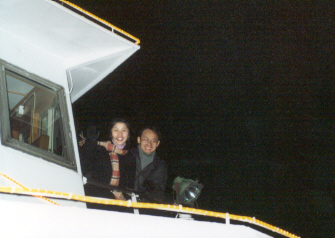
We took an evening river cruise with our excellent guide Ray and his excellent girlfriend Emma, and afterward they accompanied us to a hot pot restaurant, where we were served a kind of do-it-yourself soup which cooks at the table. The pot is divided into two sections, one very spicy and one mild, and many dishes of raw foods are brought to the table, such as thinly sliced lamb and beef, prawns, rice dumplings, seafood dumplings, Spam (yes, Spam), a turtle, a duck and many vegetables. You cook everything in the broth and then dip the pieces in a kind of sate sauce. When everything is cooked you can sip the rich broth, if you aren't already full.
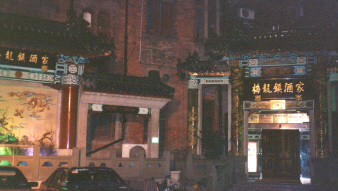
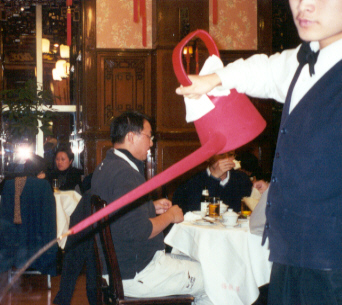
Another evening, we ate at a very fine restaurant, probably one of the best in Shanghai, called Meilongzhen, where they pour tea from a pot with a long spout. I read somewhere that the reason for the long spout is so the server could keep a discrete distance from the Empress while pouring her tea. The restaurant is in kind of an alley way so it was a little tricky to find (as many addresses in Shanghai are) but the food was some of the best we had in China.
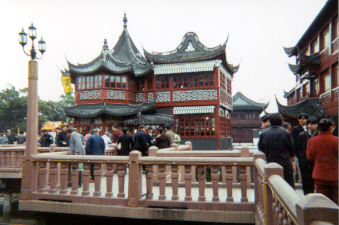
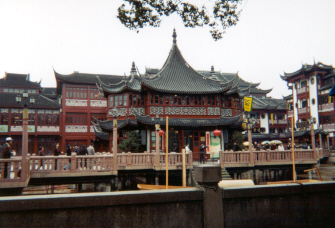
The pictures at the bottom are of the Huxinting Tea House (quite the place for a power breakfast, Ray said) and the zigzaged Bridge of Nine Turnings (nine, the number that symbolizes longevity and zigzaged because evil spirits are unable to turn corners) in Shanghai's Old Town (Nanshi), near the entrance to the Yu Yuan, a classical Chinese Garden.
|
|
|
|
|
|
|
|